Perfusion Leadership & Management
The first leadership playbook written for perfusionists

Running the pump is one responsibility. Leading the department is another.

A leadership manual for perfusion. Built from thirty-five years of practice and twenty-five at one of the country's largest academic medical centers.

$95 hardcover. Publication date coming soon. One email when it’s available. No spam. Your address is never shared or sold.


Why this book exists

Most perfusionists are trained to run a pump. Almost none are trained to lead the department: the staffing, the budget, the call schedule, the culture, the system that has to deliver the same excellent care at 3:00 AM as it does at noon.

This book is that training. Built from thirty-five years of practice, twenty-five at a major academic medical center, and the rare combination of a doctorate in health administration and a lifetime at the heart-lung machine, it gives the working perfusion leader one complete route through the job: become the leader, build the team, run the department as a system, and lead ahead of it.

The patient is the throughline of every chapter. The question behind every decision: What outcome are we protecting?


The framework

Twelve pillars of a high-reliability department.

Diagram of the twelve pillars arranged around a central emblem
Safety

Protect the patient first, every time.

Quality

Reduce unwanted variation without punishing people.

Outcomes

Measure what actually matters to the patient.

Value

Spend where it protects care.

Performance

Know how your department is really doing.

Workforce

Hire, develop, and keep the right people.

Innovation

Adopt new tools without surrendering judgment.

Research

Turn practice into evidence.

Vigilance

See the problem before it becomes the event.

Operations

Make call, coverage, and inventory run on purpose.

Consistency

Same excellent care at 3:00 AM as at noon.

Education

Teach judgment, not just steps.

What’s inside

Four parts. One route through the job.

The transition from running the pump to running the system: the first budget, the first hard decision, the boundary that comes with the title, and hiring the team you want to become.

  1. 1. All You Have Is Your Service Perfusion school trains you to run a pump, not to lead a department — and leadership lands on you anyway. This chapter exists because the only currency you start with is the quality of your work, and that has to be enough to carry you through the transition.
  2. 2. From Running the Pump to Running the System The pump is one patient. The job is the whole system. Written to make the mental shift from case management to department management visible before it gets made for you.
  3. 3. The First Budget: Learning the Second Language Clinicians and administrators speak different languages, and the one who stays monolingual loses. Written from the year a new chief perfusionist sat across from a CFO and learned to speak money without giving up medicine.
  4. 4. The Decision Is Yours There is a moment in every leader's life when you realize nobody is coming to make the call for you. This chapter exists to prepare you for judgment under uncertainty instead of being surprised by it.
  5. 5. The Leadership Boundary and the Loneliness of Management Leadership costs you a certain kind of closeness, and pretending otherwise makes it worse. Named plainly because nobody warns you on the way up.
  6. 6. Hiring the Team You Want to Become Every hire is a vote on the department's future. Written to replace popularity-driven hiring with a system: the manager screens first, the staff assesses fit, and the manager owns the decision.

High reliability at the pump, just culture, trust and decentralized judgment, reading the room, and the small things that become big things.

  1. 7. High Reliability Perfusion Industries that cannot afford failure built reliability science; the pump room is where it fits tightest in medicine. This chapter translates high-reliability principles into perfusion practice.
  2. 8. Extreme Ownership in the OR Ownership is a diagnostic tool, not a hair shirt. It exists to show how to examine what the leader and the system contributed to a failure without collapsing into blame of anyone, including yourself.
  3. 9. Just Culture in the Perfusion Suite A department that punishes honesty gets silence, and silence kills patients. Written to separate system failure from human error, at-risk behavior, and recklessness — and to hold accountability on both sides of the desk.
  4. 10. Factors of a Leader: Knowing Your Shape and Theirs You cannot lead people you have reduced to labels. This chapter treats personality frameworks as instruments for understanding, not boxes for filing people.
  5. 11. The Three-Person Department Small teams inside big 24/7 systems have their own physics. Written about the dynamics nobody models — the three-person department living inside a thousand-bed institution.
  6. 12. Trust and Decentralized Judgment The 2:00 AM question: what happens when you are not there? This chapter builds staff who can act safely without you — and now carries the book's section on reading the room, the situational awareness that makes decentralized judgment possible.
  7. 13. Small Things That Become Big Things A dead pager battery is a patient-safety event waiting to happen. It exists because disproportionate risk hides in the details leaders are most tempted to delegate and forget.
  8. 14. The Score Is a Signal Metrics only matter if the people being measured own the response. Written from a real staff-owned turnaround: action planning belongs to the team, not to the chief.

Structure, process, outcome. Call coverage, inventory and redundancy, the preparedness paradox, unwarranted variation, and data as the department's learning system.

  1. 15. Structure, Process, Outcome You cannot fix what you have not decomposed. Exists to give leaders the backbone — design backward from the outcome you are protecting.
  2. 16. Staffing and Call Coverage The schedule is where promises to patients meet the limits of humans. Written about coverage design, the discipline of one 24/7 number, and the complexity hidden behind a simple interface.
  3. 17. Inventory and Redundancy Readiness has an economics. This chapter makes the case that redundancy is not waste — it is the price of never having to explain a missing pump.
  4. 18. Standard Department Administration: Claims, Requirements, and Records in Alignment Departments get hurt by paper, not pumps. This chapter exists to keep three things in agreement, what the department claims it does, what the manufacturer requires, and what the record can prove, because that triangle is what a surveyor, an attorney, or a new chief tests first.
  5. 19. The Preparedness Paradox Prevention that works becomes invisible, and then it gets cut. Named because the better you are at preventing problems, the more you must defend the budget that prevented them.
  6. 20. Simple but No Simpler Simplification that removes a safeguard is not efficiency. This chapter defines minimum effective complexity and defends the safeguards that look like friction.
  7. 21. Quality Assurance and the Reduction of Unwarranted Variation Variation is where patients get lost. Written to hand leaders the statistical and cultural tools — control charts, improvement cycles, patterns of accountability — that turn data into better care.
  8. 22. SBAR: Structured Communication That Saves Lives Most clinical communication fails before it starts because it has no structure. Exists to give the whole room a common format so the message lands the first time.
  9. 23. Electronic Charting and Operational Intelligence Chart data is either a compliance chore or a management asset. Written to make the case for treating the record as the department's learning system.

Abnormal conditions, change and new programs, AI as a force multiplier (not a replacement for judgment), and building the next generation that outlives you.

  1. 24. The Responsibility to Contribute: Why the Excuse Is Gone Practice knowledge that never leaves the room dies with the room. This chapter is the working leader's charge: capture it, teach it, publish it, mentor it — convert observation into the profession's durable knowledge.
  2. 25. Hold the Swiss: Managing Abnormal Conditions Normal operations are engineered; abnormal operations are survived. Written for the moments when the holes line up and the only thing between the patient and harm is calibrated human judgment.
  3. 26. Change Management and New Program Development New programs rarely fail on clinical merit; they fail on change management. This chapter is the playbook for building what does not exist yet without breaking what already does.
  4. 27. AI-Enabled Perfusion Leadership AI has arrived in the pump room; leadership has not yet decided what to do with it. Exists to frame AI as a force multiplier for forecasting, synthesis, and decision support — with judgment permanently remaining human.
  5. 28. Developing the Next Generation and Succession A department that cannot outlive you is not a system. This chapter is the leader's exit strategy: build people, judgment, and pathways that survive you.

Twenty-eight chapters and a provenance appendix.


Who it’s for

New and aspiring chiefs

The training nobody gave you, before the job changes.

Working perfusion leaders

A field manual for the decisions you face every week.

Staff perfusionists

Understand how your department is run, and how you lead without the title.


About the author

Anthony G. Shackelford has practiced perfusion for thirty-five years, the last twenty-five at the Medical University of South Carolina, where he taught clinical monitoring and instrumentation in the cardiovascular perfusion program for eleven years, along with perfusion devices. He taught organizational leadership theory to perfusion students at Thomas Jefferson University for five years, and holds a Doctor of Health Administration and a Master of Health Administration, both earned with honors. He lives in Charleston, South Carolina, with his wife, Alisa.

Experience
35 years in perfusion practice
Education
DHA & MHA, with honors
Credentials
CCP since 1993 · CCT since 1991
Teaching
18 years across perfusion and doctoral programs

Be first in line

The hardcover is coming.

Join the list and you’ll know the moment it’s available. No spam, just the launch.

One email, that’s it. Your address is never shared or sold.

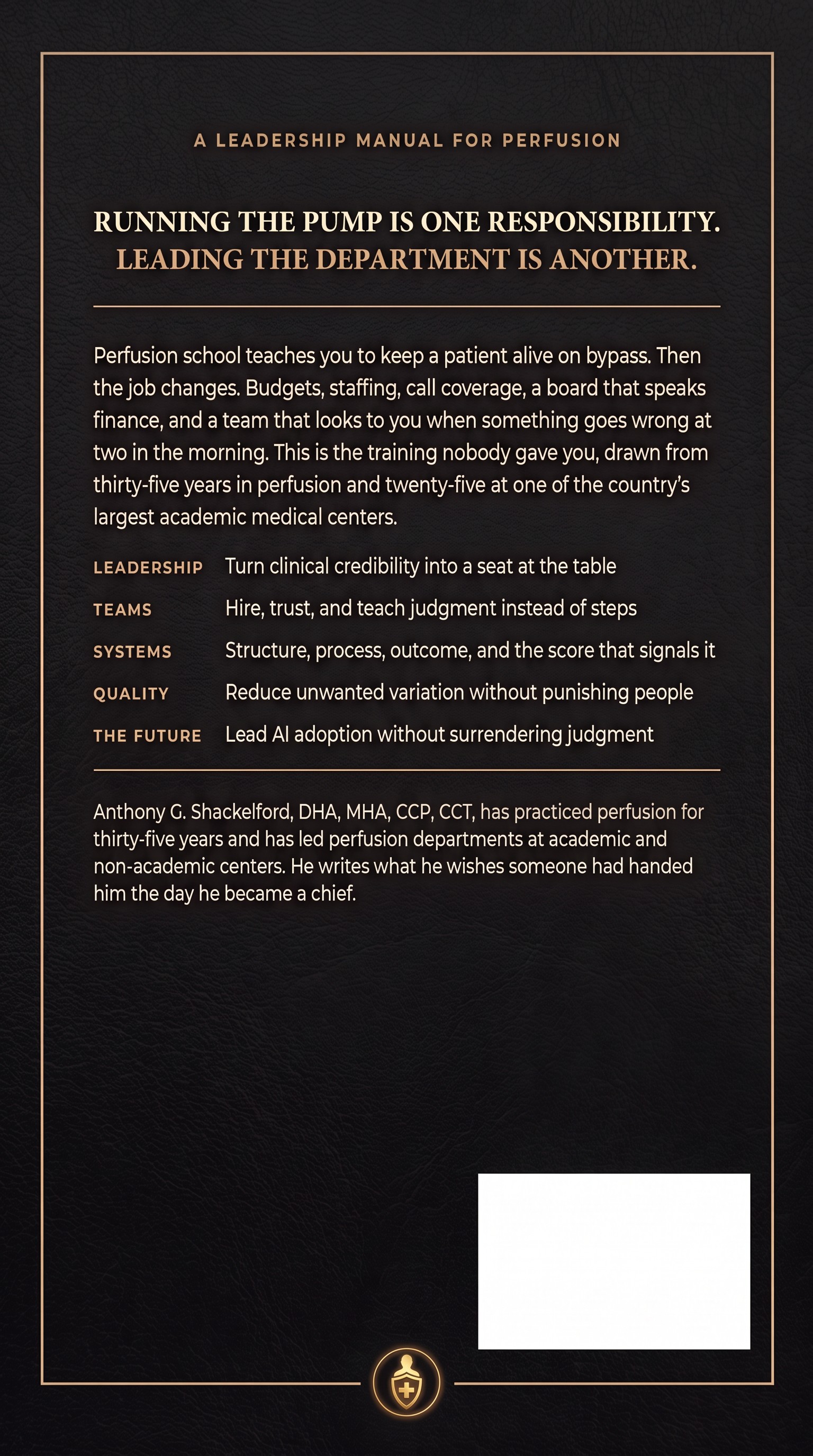
Back cover of Perfusion Leadership & Management

The column

The Inflow

Most papers end with a call for more research. Somebody still has to answer for tonight's case. The Inflow reads one piece of the perfusion literature a week and asks the only question that matters at the pump: what do I do with this today?

Read The Inflow →